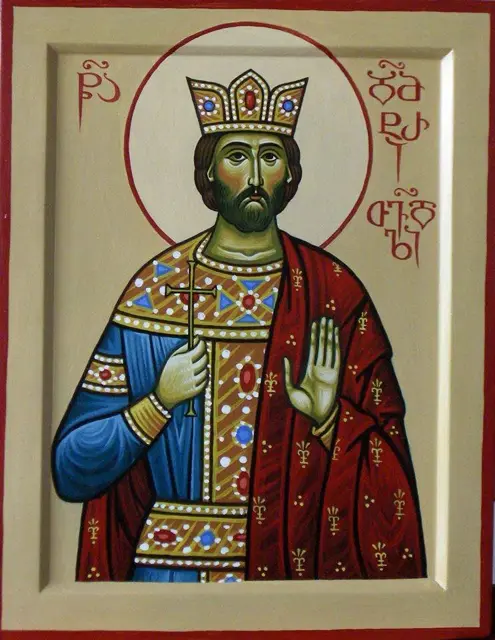
Holy King Demetre the Self-Sacrificing
He could have fled and saved his life, but he knew that the Georgia left behind him would pay for it in blood. So Demetre chose the road of death and offered his own life for his nation. When the sword fell, the king's life ended, but a name was born that the centuries could no longer erase: the Self-Sacrificing. For sometimes a king's greatest victory is written not in battle, but in a life given for his people.
- Feast
- 12 (25) March
The holy King Demetre II the Self-Sacrificing is one of the outstanding kings in the history of Georgia and a saint of the Georgian Orthodox Church. His life fell in one of the hardest periods of 13th-century Georgia, when the country was under Mongol rule and the Georgian kings were forced to govern the state in a difficult political situation. Demetre's name has remained for ever in Georgian history not only as that of a king and commander, but as that of a ruler who in the end gave up his own life to save his nation.
Demetre II was born in 1259. He was the son of King David VII Ulu of Georgia and Queen Gvantsa, and a great-grandson of the holy Queen Tamar. His childhood was marked from the start by heavy trials. Demetre was still a small child when the Mongols put his mother, Queen Gvantsa, to death. A few years later, at about the age of ten, he lost his father as well.
The future king grew up from childhood in an age when Georgia's political independence was severely restricted. The Mongol state of the Ilkhans demanded from the kings of Georgia obedience, tribute and participation in military campaigns. In such circumstances kingship was not only honour and power, but constant political danger and a heavy responsibility.
After the death of David VII Ulu the young Demetre was presented at the court of the Mongol khan to be confirmed as king. About 1270 Demetre II came to the throne of Georgia. Beside the king, still a boy, great political influence was held by Sadun Mankaberdeli, a powerful feudal lord close to the Mongol court.
On his return to Georgia Demetre was consecrated king according to the rite of the Church. A country in grave condition fell to his lot: a people weakened by long years of war and Mongol taxes, deserted places, and a state that had to defend its own interests under the constant pressure of the mighty Ilkhans.
Despite his youth, Demetre tried to improve the condition of the country. Church tradition and the Georgian chronicles especially note his mercy and his love for the poor. The king was in the habit of going out secretly into the city by night to visit the needy, orphans and the bedridden and to give them alms with his own hand.
Demetre also cared for churches and monasteries, built and restored churches and strengthened the fortresses important to the country. Especially linked with his name is the Metekhi Church of the Mother of God in Tbilisi. The king developed a monastery in the grounds of the royal palace of Isani, endowed it with estates and saw to it that the monks had what they needed.
Yet Demetre's reign could not be a peaceful one. As a king dependent on the Mongol Ilkhans, he was obliged to take part in their military campaigns with the Georgian army. The Georgians fought in various parts of the Near East, including the hard battles against the Mamluks of Egypt.
Demetre himself took part in these campaigns, and the sources note his great courage. But the Georgians' part in foreign wars came at a heavy price: thousands of warriors perished, and an already weakened Georgia lost still more of its human and economic resources.
Demetre's life did not consist only of victories and virtues. The tradition of the Georgian Church does not hide the spiritual fall that took place in his life. In a difficult political setting the king entered into several marriages. One of them was due to political ties with the circle of the Mongol nobility, and later Demetre fell in love with Natela, daughter of Beka Jakeli, and took her as his wife. Of Natela was born the future great Georgian king George V the Brilliant.
The king's irregular marriages became the cause of stern rebuke from the Church. He was reproved by Georgian clergy, among them Catholicos Nikoloz and the venerable Basil, who had come to Georgia from Mount Athos. The Church's account presents these events as an important spiritual trial in Demetre's life.
This makes the life of Saint Demetre especially human and profound. The Church does not present him to us as a man who never sinned. At the end of his life, however, it was precisely the conscious sacrifice of his own life, his love for his nation and his Christian readiness before death that became the highest labour, which established his name for ever in the history of the Church of Georgia.
At the end of the 13th century a fierce political struggle began in the state of the Ilkhans. After the death of Abaqa Khan, Arghun Khan finally prevailed in the struggle for power. One of the most influential men at his court was the vizier Bugha, to whom Demetre was bound by ties of kinship and politics.
In 1288 a conspiracy against Arghun was uncovered. Bugha was accused of plotting and put to death. His relatives and political allies also came under persecution. Demetre, as a man close to Bugha, was summoned to the khan's court.
The king knew well what this order might mean. A choice lay before him: to flee and take refuge in the inaccessible places of Mtiuleti, or to appear before the khan and put his own life in danger.
Demetre gathered the Catholicos, the bishops, the fathers of the monasteries and the members of the royal council. The nobles advised him not to go to the Horde and to take shelter in a safe place. There was also the possibility of armed resistance and of fortifying himself in the mountains.
But the king chose another way.
He knew that if he disobeyed, the wrath of the Mongols would fall upon the common people. Towns and villages might be sacked, churches destroyed and countless innocent people killed.
It was then that Demetre showed the quality that gave him an everlasting name: self-sacrifice.
The king declared that he could not choose to save his own life if his people were to perish because of it. The essence of his decision was expressed in a single sentence:
“I will lay down my life for my nation.”
This decision was the conscious choice of Christian sacrifice. Demetre knew that going to the khan might end in death, yet he still resolved to offer himself in order to protect Georgia from fresh devastation and bloodshed.
Catholicos Abraham saw in the king's decision the highest expression of the love taught by the Gospel: the love of one who lays down his life for his neighbour.
Demetre set out for the Horde. With him went Catholicos Abraham, the priest Mose, his son David and Georgian nobles. On the way the king was seized, his property was taken, his hands were bound and he was brought before the khan like a prisoner.
In the inquiry no proof was found of Demetre's direct part in the conspiracy. Nevertheless, an important role against him was played by Khutlu-Bugha, son of Sadun Mankaberdeli, who suggested to the khan the possibility of setting another king in Demetre's place.
In the end Demetre was condemned to death.
The Georgian nobles even proposed to the imprisoned king that he escape. He still had the chance to save his life, but Demetre refused a second time. He was convinced that if he fled, vengeance would once again fall upon innocent people.
Thus his self-sacrifice was not the decision of a single moment. He chose this road knowingly and did not change his resolve even when death already stood directly before him.
The holy king received the sentence of death with Christian calm. According to tradition, he comforted the Georgians who came to him and even asked Khutlu-Bugha, the man whose actions had played an important part in his condemnation, to protect his young son David.
Before his death Demetre prayed, received Holy Communion and commended his soul to God.
On 12 March 1289 the holy King Demetre II the Self-Sacrificing was beheaded. He was about thirty years old. Georgian Church tradition relates that at the time of his death the sun was darkened and a sudden darkness fell, which greatly frightened those who were there.
At first the king's body was kept under guard. Later Catholicos Abraham and the priest Mose secretly ransomed his holy body and, with the help of the Georgians, brought it home.
Demetre the Self-Sacrificing was buried in Mtskheta, in Svetitskhoveli Cathedral, in the resting place of his royal ancestors.
After his death the Georgian people kept the king's last decision in their memory with special love. Demetre II entered history under the name “the Self-Sacrificing”: the king who gave himself and his life for his nation.
This name does not denote a heroic death alone. In his case the word “Self-Sacrificing” expresses a conscious sacrifice: the giving up of one's own life to save others. That is why the story of Demetre is one of the most powerful examples of Georgian Christian kingship.
The Georgian Orthodox Church canonised Demetre II and honours him as the holy martyr King Demetre the Self-Sacrificing. At the centre of his holiness stands that ideal of Christian love according to which a person's greatest love is to give his own life for his neighbour.
The Georgian Orthodox Church celebrates the memory of the holy King Demetre the Self-Sacrificing on 12 March (25 March), according to the old and the new calendar.
Today the name of Demetre the Self-Sacrificing is linked for Georgia at once with kingship, human weakness, repentance, responsibility and final sacrifice. His life reminds us that holiness does not always mean a sinless life: in Christian tradition what may be decisive is a person's final choice, repentance and readiness to give himself for love of others.
Demetre could have fled. He could have saved his own life and prepared for battle. But he knew that the price might be the lives of his subjects. So the young king chose himself as the sacrifice, and not his nation.
It was this choice that gave him the name which, eight centuries later, is still alive in Georgian historical and Church memory: the holy King Demetre the Self-Sacrificing.
Hymns of the Holy King Demetre the Self-Sacrificing
🎵 Troparion (Tone IV)
სამეფოისა გვირგვინისა დამტევებელმან აღირჩიე სიკუდილი და დასთხიე რაი სისხლი შენი ხსნისათვის ერისა შენისა, ღმრთისა მიერ მოიღე წარუვალი გვირგვინი დიდებისაი, წმიდაო მოწამეო დემეტრე, და მეოხ ხარ ჩუენთვის მისა მიმართ, რაითა მოგვიტევოს შეცოდებანი ჩუენნი, და გვიხსნნეს ყოვლისაგან ბოროტისა.
🎵 Kontakion (Tone II)
ასპარეზი სიმხნისაი და მოსაგებელი უხრწნელისა ძლევისაი განიმზადა რაი შენთვის საღმრთოითა წინა-განგებითა, არა შეძრწუნდი შიშისაგან სიკუდილისა და შეურაცხ-ყავ რაი საწუთოი იგი დიდებაი, ძეებრივი გულმხურვალებითა დასდევ თავი შენი მამულისათვის და ერისა, რომლითა მიხვედ უკუდავებად, წმიდაო მეფეო დემეტრე, და განაბრწყინე ეკლესიაი ქართუელთაი.


